About Lantern Hunt

A decentralized, people-powered campaign to protect native habitats and eradicate invasive species.

That is our mission. We started with one species and one app.

Our work

Three parts, one mission.

Removal

Direct removal

People find invasive species and remove them, one verified record at a time.

Education

Knowing the species

Participants learn what to look for and when, so removal is accurate and safe.

Geographic data

Knowing the place

Reports show where invasive species are concentrated and spreading, so researchers, agencies, and conservation groups know where to focus.

What these add up to

Why people-powered

The people who notice first are usually the people who live there.

Invasive species move through backyards, parks, farm edges, parking lots, and shorelines. Professional programs do essential work, but they cannot be everywhere at once.

Residents, growers, hikers, and landowners are already in those places. Many of them want to help and have no structured way to do it, or no way to show that what they did was real.

Lantern Hunt gives them guidance on what to look for, a simple way to act, and a reviewed record of the work. Add financial incentives for particular species and priority areas, and those individual acts become a coordinated effort that can operate across communities, regions, and eventually the world.

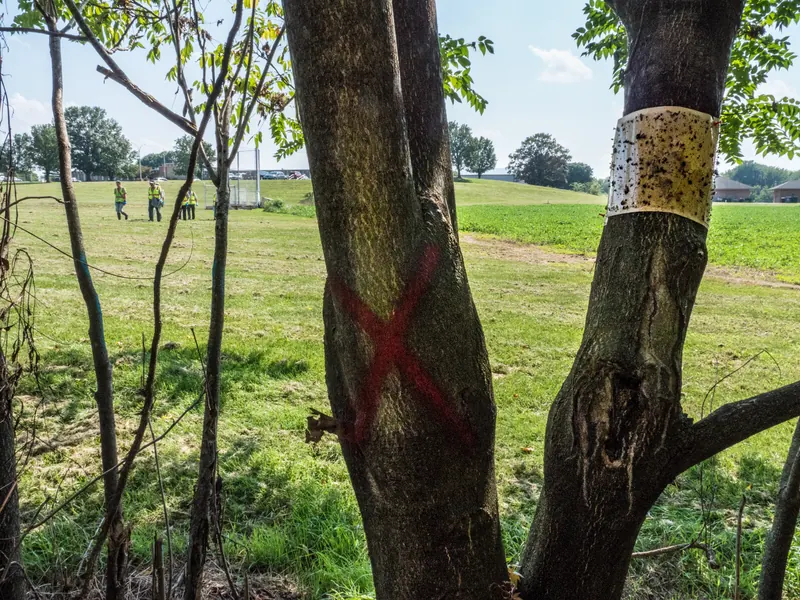
A tree wrapped in a sticky band covered with trapped spotted lanternflies, with a field and survey crew in the background.
A sticky band used to monitor spotted lanternflies on a tree in Pennsylvania, 2018. Credit

History

Mobilizing people against harmful species is an old idea.

Governments have paid farmers by the bushel, trappers by the tail, and contractors by the foot. Four campaigns show how it has been done.

Minnesota · 1877

A bounty by the bushel

After four summers of Rocky Mountain locust swarms, a native pest that was devouring the state’s crops, Minnesota’s legislature paid bounties for grasshoppers and their eggs: a dollar a bushel for grasshoppers caught before May 25, falling to 20 cents by summer, and 50 cents a gallon for eggs. Township officials measured each catch and destroyed it, and farmers dragged tar-coated “hopper dozers” across their fields. The swarms left that summer on their own, but the bounty is one of the earliest examples of a state paying ordinary people for the amount of a pest they removed.

Source: Minnesota History, 1958; MNopedia

Louisiana · since 2002

Paid by the tail

Nutria, large South American rodents, eat marsh plants down to the roots and speed the loss of Louisiana’s coastal wetlands. Since 2002 the state’s Coastwide Nutria Control Program has paid registered hunters and trappers for every nutria tail they turn in, now $6 a tail. Participants remove roughly 170,000 to 450,000 nutria a season, and the state reports that marsh damage from nutria has fallen by more than 90 percent.

Source: Louisiana Department of Wildlife and Fisheries

Florida · since 2017

Paid by the hour and by the foot

The South Florida Water Management District and the Florida Fish and Wildlife Conservation Commission pay contractors to remove invasive Burmese pythons from the Everglades. District contractors earn an hourly wage of $14 to $30 depending on the area, plus $50 for each python up to four feet, $25 for each additional foot, and $200 for each verified active nest. By spring 2025, contractors in the two programs had removed more than 11,000 pythons.

Source: SFWMD; Florida FWC

Japan · 1993–2024

An island cleared

About 30 mongooses were released on Amami-Ōshima in 1979 to control venomous habu snakes. They preyed on the island’s rare native wildlife instead and grew to about 10,000. Paying trappers for each mongoose, up to ¥5,000 by 2004, cut their numbers. From 2005 the Ministry of the Environment employed a full-time professional team, the Amami Mongoose Busters, using more than 30,000 traps, cameras, and detection dogs. More than 32,000 mongooses were removed, the last in 2018, and in 2024 Japan declared the island mongoose-free. Native species such as the Amami rabbit are recovering.

Source: Japan Ministry of the Environment
What Lantern Hunt adds

The same idea, open to anyone with a phone.

Most of those campaigns relied on licensed trappers or hired contractors working in one region. Lantern Hunt lets anyone take part, wherever they are.

Participation
A free iPhone app. No license, no training course, and no name or email address needed.
Education
Guides that teach people to recognize each life stage and remove it safely
Verification
Before and after photographs on every removal, reviewed by a person
Geographic data
A growing record of where invasive species are being found, shared with the public by state and county
Incentives, next
Partner-funded rewards for particular species in priority areas. The proposal

How we work

Four principles.

Open to everyone

Anyone with an iPhone can take part for free. Accounts need no name or email address.

Verification before credit

A removal counts only after a person has reviewed it. Points, maps, and any future payments rest on that step.

Privacy by default

Locations are shown at reduced precision, photos lose their original metadata, and the app has no third-party tracking software.

Official guidance first

We are not a government agency. Participants should follow their state’s rules and report sightings through official channels too.

Where we are

Where Lantern Hunt stands today.

The iPhone app is live, and participants have recorded more than 2,000 verified kills in six states. Sponsored campaigns and new species are the next stage. Five candidate species, from Scotch broom to European green crab, are described on the Impact and Partners pages.

The six species   Partnerships

Product
Lantern Hunt for iPhone, free on the App Store
Requires
iOS 17.6 or later
First species
Spotted lanternfly, Lycorma delicatula
Launched
September 29, 2026
Based in
United States
Independence
Not affiliated with, endorsed by, or acting on behalf of any government agency or environmental organization